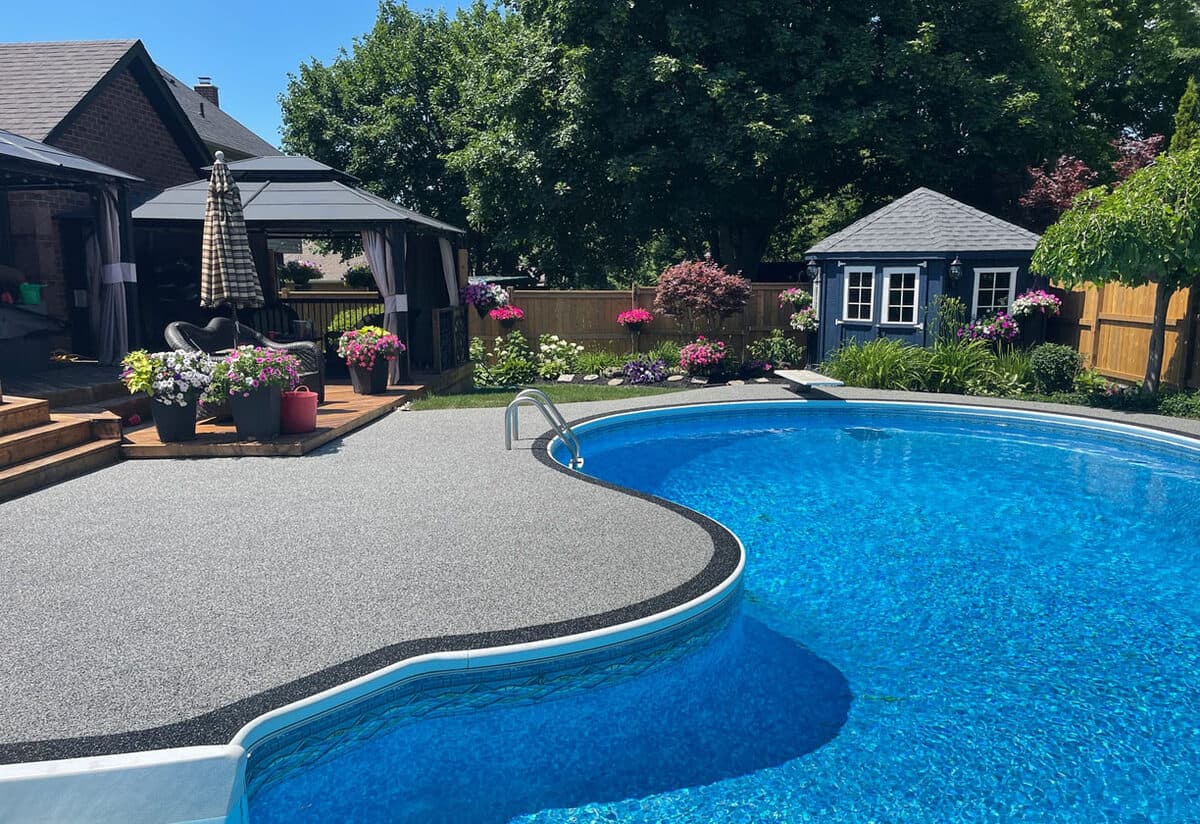
If you've been looking into pool deck options for Las Vegas, you've probably run into the same problem we hear about every week: your concrete is too hot to walk on, your cool deck needs resealing again, or you're tired of the deck cracking every summer. Rubber pool deck flooring solves all three. It's the coolest surface you can stand on barefoot in July, it only needs resealing every 3–4 years instead of every 1–2, and it flexes with your concrete instead of cracking on top of it. We're ProShield Epoxy, and we install rubber pool decks across the Las Vegas valley every week — here's everything you need to know before you book.
In This Article
What Is Rubber Pool Deck Flooring?
Rubber pool decking is a poured-in-place surface made from EPDM rubber granulesbound together with a UV-stable polyurethane resin. The rubber granules come in dozens of colors — grays, tans, earth tones, and custom blends — and are hand-troweled directly over your existing concrete to create a seamless, textured surface that's typically 3/8-inch to 1/2-inch thick.
Unlike spray-applied coatings like cool deck or knockdown texture, rubber decking has actual physical mass between your feet and the concrete. That mass acts as an insulation layer — it blocks heat transfer while also providing cushion, slip resistance, and crack bridging that rigid coatings can't match. It bonds directly to prepared concrete with no demolition, no ripping out existing material, and no weeks of construction in your backyard.
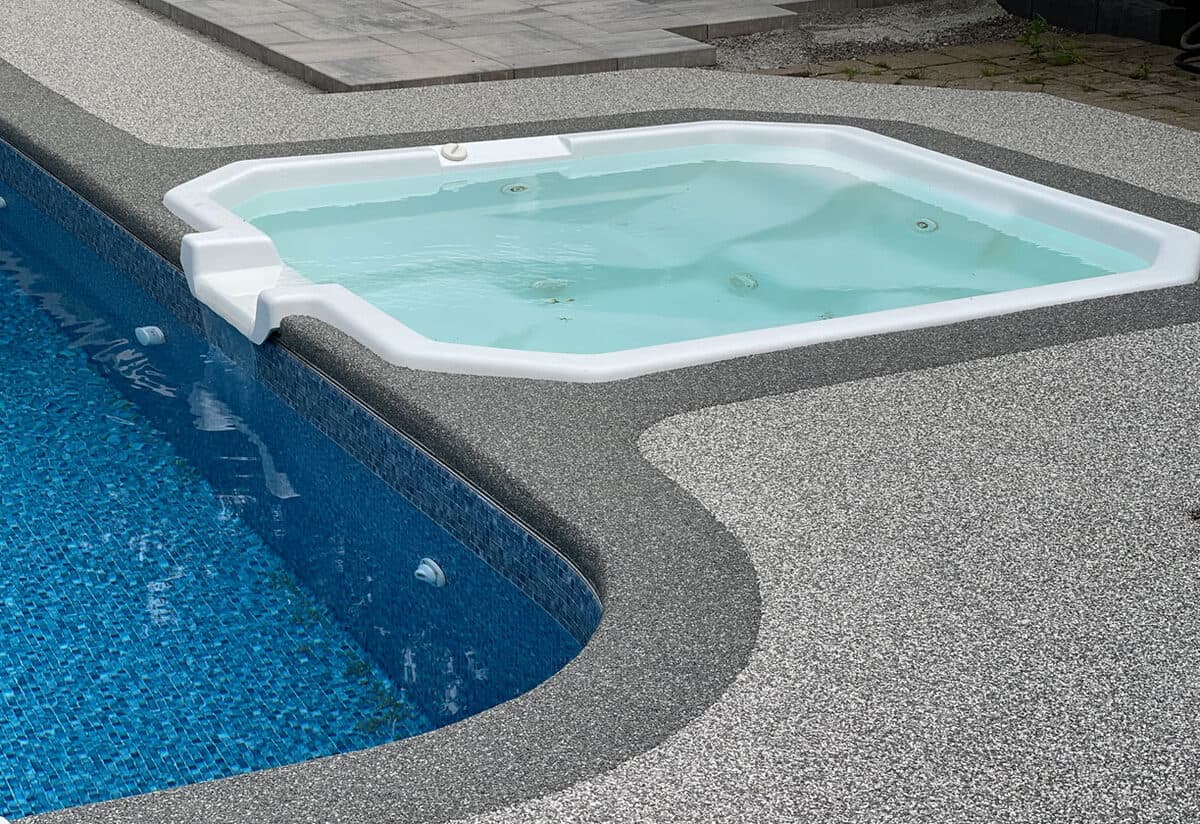
Two-tone gray rubber deck around a pool and spa — the textured granules provide built-in slip resistance even when wet
Why Rubber Works Better Than Anything Else in Las Vegas
Las Vegas is one of the hardest environments in the country for pool deck surfaces. You've got 115°F+ air temps, concrete slabs hitting 170°F in direct sun, daily temperature swings of 40–50°F that expand and contract everything, and relentless UV that degrades most coatings within a few years. Rubber pool decking handles all of it — here's why:
It stays ~60°F cooler than bare concrete. In peak summer conditions, rubber deck surfaces reach around 110°Fcompared to 170°F for uncoated concrete. That's not just a comfort difference — it's the difference between walking to the pool barefoot and sprinting across burning concrete in sandals. The rubber layer insulates your feet from the hot slab below, and the material's low thermal conductivity means heat transfers to your skin slowly even when the surface is warm.
It doesn't crack when your concrete moves. Las Vegas concrete moves constantly — daily thermal cycling causes expansion and contraction that creates hairline cracks over time. Rigid coatings and hard surfaces telegraph those cracks right through to the finished surface. Rubber decking is flexible — the elastomeric membrane spans cracks up to 1/8-inch without breaking or showing through. If your existing deck already has crack networks, this is a major advantage.
Slip resistance that actually works when wet. Pool decks are wet by definition. The textured rubber granules provide inherent traction that stays grippy over time because the grip is built into the material itself, not applied as a topcoat that wears off. Our system exceeds ADA slip resistance standards.
Cushioned impact protection. Kids run around pools. People slip. On concrete or stone, a fall means scraped knees or worse. Rubber decking provides genuine shock absorption — the same material principle used in commercial playground surfaces. A slip on rubber is a non-event. A slip on concrete can mean stitches.
UV and chemical resistance built in. The polyurethane binder is formulated for extended UV exposure and maintains its integrity for years without the periodic resealing that most other pool deck coatings require in Las Vegas. The rubber granules are chemically inert — resistant to chlorine, salt, muriatic acid, and whatever your pool water splashes across the deck daily.
How Much Does Rubber Pool Decking Cost in Las Vegas?
We're not going to make you fill out a form to get a ballpark. For most residential pool decks in the Las Vegas area, rubber pool deck flooring runs $15 to $18 per square foot, installed. That includes surface prep, primer, the full rubber aggregate system, and the UV-stable topcoat.
For a standard pool deck around 600 square feet, you're looking at roughly $9,000 to $10,800 depending on the condition of the concrete, how complex the deck layout is (coping, drains, expansion joints, stairs), and which color blend you choose.
What affects the final price? Concrete condition is the biggest variable. A clean, sound slab with minimal cracking is straightforward. A deck with significant cracks, old delaminating coatings, or drainage issues needs more prep work before we can pour. Every job gets a free on-site estimate where we look at your actual deck and give you a flat number — no surprises.
For comparison: cool deck resurfacing runs $6–$9/sq ft, pavers run $10–$20/sq ft, and travertine runs $15–$27/sq ft. Rubber sits right in the middle on upfront cost but comes with the lowest maintenance burden long-term — reseal every 3–4 years vs cool deck's 1–2, and the rubber reseal is just a pressure wash and clear coat. No re-sanding, no annual sealing.
Want an exact number for your pool deck? Get a free estimate — we'll come out, walk your deck, and give you a flat price on the spot.
How We Install Rubber Pool Decking
One of the biggest advantages of rubber decking is the installation process. It goes directly over your existing concrete — no demolition, no jackhammering, no weeks of construction disrupting your backyard. Most pool decks are done in 2–3 days.
Day 1 — Surface Preparation.We grind the existing concrete to create a proper bonding profile, fill any significant cracks with flexible filler, and clean the surface of all contaminants. If there's an existing cool deck or acrylic coating, we remove any loose or delaminating material. Sound, well-bonded existing coatings can typically stay in place. This step is everything — skip it or rush it and the system fails.
Day 1–2 — Primer & Pour.A polyurethane primer is rolled onto the prepared concrete to seal it and create the bond surface. Once the primer tacks, we mix the rubber granules with the polyurethane resin and hand-trowel the mixture onto the deck at the specified thickness. Around coping, drains, expansion joints, and transitions, we detail the material to create clean, waterproof edges. This is where craftsmanship matters — the transitions and details are what separate a professional install from a sloppy one.
Day 2–3 — Topcoat & Cure. A UV-stable topcoat seals the rubber surface and locks the granules in place. Cure time is typically 24 hours before light foot traffic and 48–72 hours before furniture and normal use.
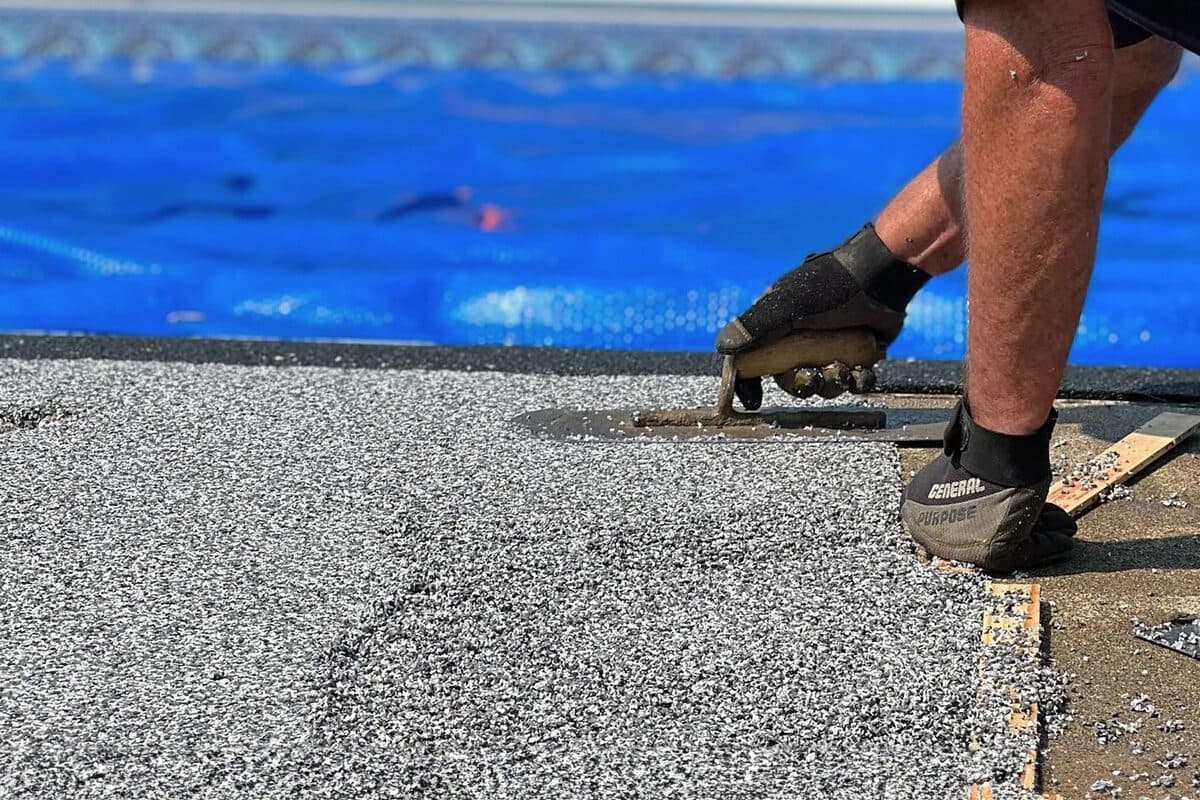
Hand-troweling the rubber aggregate mixture onto prepared concrete — this is where craftsmanship matters
Colors & Design Options
Rubber pool decking comes in a wide range of color blends. We carry everything from classic desert tones — sandstone, tan, warm gray — to bolder options like terracotta, slate blue, and custom multi-color blends. Most Las Vegas homeowners go with earth tones that complement their exterior and landscape, but we can match just about anything.
We'll bring physical samples to your estimate so you can see the actual colors on your concrete in your lighting. Screens don't do them justice — the texture and color shift depending on sunlight and angle, and you want to see it in person before you commit.
You can also do multi-zone designs — one color around the pool edge, a different color for the main deck area, borders, patterns, or accent bands. The material is hand-troweled so we have full control over where each color goes.
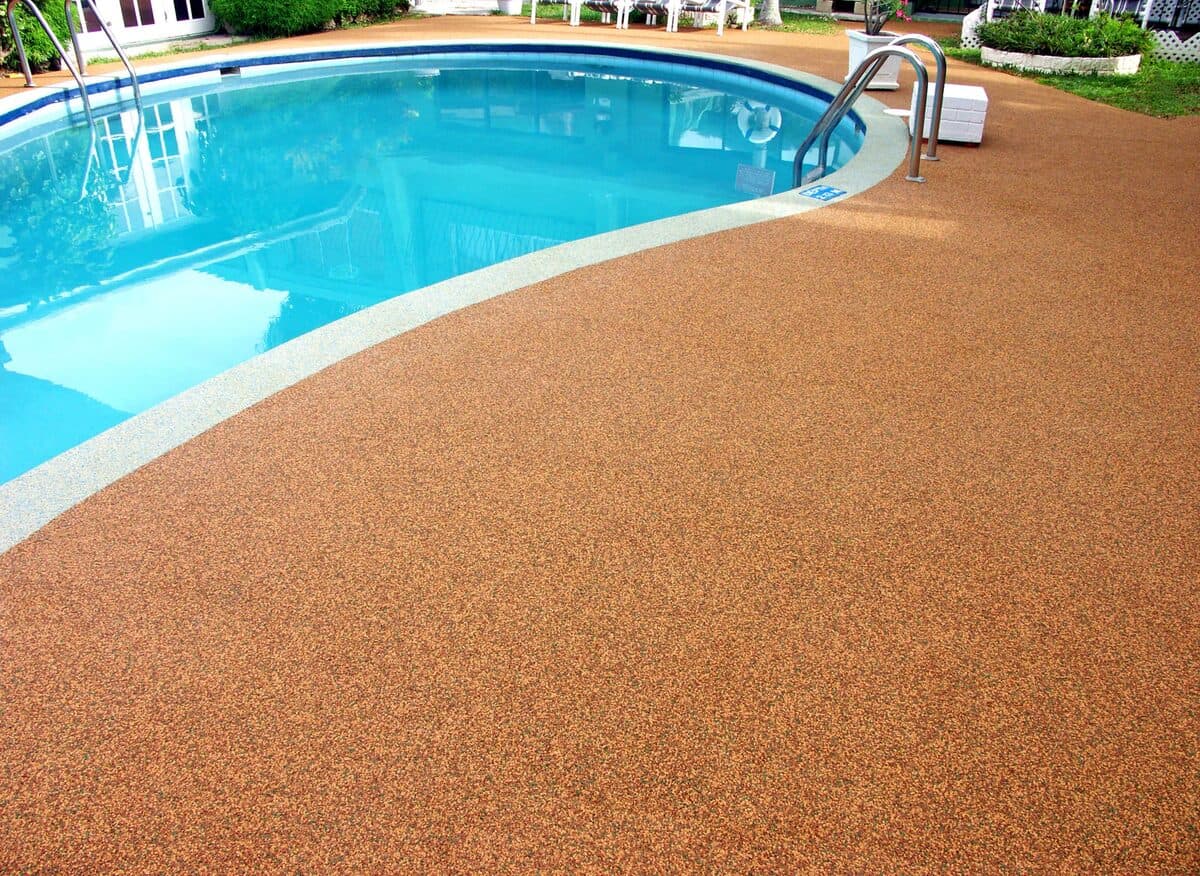
Terracotta/copper rubber deck — one of many color blends available
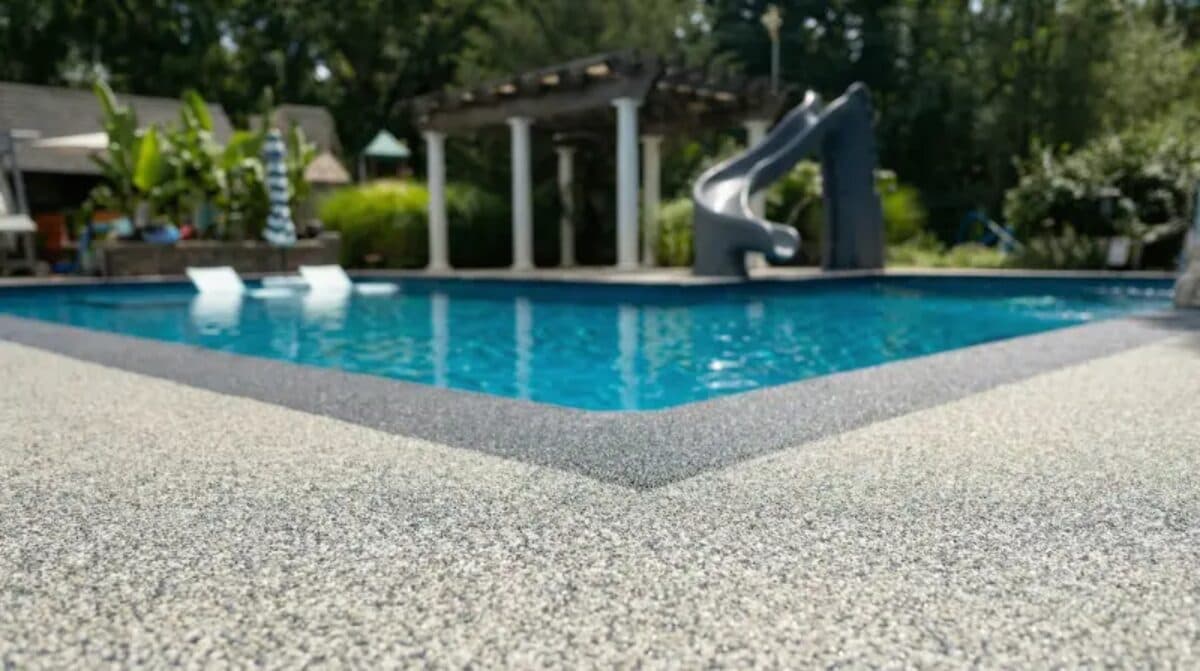
Finished rubber deck with slide and pergola — seamless coverage from pool edge to outdoor living area
Maintenance & Longevity
This is where rubber pool decking really separates itself from other options. The maintenance is minimal:
Weekly:Blow or sweep debris. That's it.
Monthly:Rinse with a hose. For anything stubborn — sunscreen stains, pool chemical splatter — mild soap and water with a soft brush handles it.
Reseal every 3–4 years.Compared to cool deck's 1–2 year reseal cycle, rubber decking is way less demanding. When it's time, the process is simple: pressure wash the surface and roll on a clear coat. It's cheap, easy, and you can knock it out in an afternoon. Nothing like the involved resealing process that other coatings require.
Expected lifespan: 10–15 yearsin Las Vegas conditions. That's comparable to travertine and paver installations that cost two to three times as much, with a fraction of the ongoing maintenance.
One of our customers had a textured spray deck that was giving them nothing but problems — chipping, constant resealing, and it still wasn't that cool. His wife uses the pool every day and they spend a lot of time outside, so the deck was a real pain point. We installed rubber aggregate over the existing surface and it made a huge difference. They loved how much cooler it is, how cushy it feels underfoot, and the fact that they aren't dealing with resealing every year. That's the kind of feedback that tells you the system actually delivers.
Rubber Deck vs. Cool Deck
This is the most common question we get, and since we install both systems, we can give you an honest answer.
Cool deck is a great system at its price point. At $6–$9/sq ft installed, it's the most affordable way to drop your pool deck temperature by about 40°F. It lasts 10–15 years with proper maintenance. The trade-off is that it needs resealing every 1–2 years in Las Vegas — the UV out here is brutal on acrylic coatings. If budget is your top priority and you're disciplined about resealing, cool deck is a solid choice.
Rubber decking costs more upfront ($15–$18/sq ft) but stays about 20°F coolerthan cool deck, provides better slip resistance, cushions falls, and bridges cracks. You still reseal rubber, but only every 3–4 years instead of every 1–2 — and the process is just a pressure wash and clear coat roll-on. For homeowners who want maximum comfort, safety, and long-term value, rubber is the better investment.
We don't push one over the other — we get paid either way. At your estimate, we'll walk through both options with real numbers for your specific deck so you can make the call that makes sense for your situation.
Honest Downsides
We're not going to pretend rubber pool decking is perfect. Here's what you should know:
It costs more than cool deck.If you're on a tight budget, cool deck at $6–$9/sq ft is a real option that still reduces heat significantly. Rubber at $15–$18/sq ft is a step up in price. For some homeowners, the budget difference matters and cool deck is the right call.
Sharp or heavy objects can damage it.Dragging metal furniture, dropping heavy tools, or poking the surface with sharp objects can gouge the rubber. It's durable under normal pool deck use — foot traffic, pool furniture, kids, dogs — but it's not indestructible. Use furniture pads and don't drag metal across it.
It's not DIY.Unlike some cool deck kits you can buy at the hardware store, rubber pool decking is a professional-only installation. The mixing ratios, troweling technique, thickness control, and detail work around transitions require experience. A bad install means delamination, uneven thickness, or poor bonding — and you won't know until it's too late. This isn't a weekend project.
Color fades over time.After 7–10 years of Las Vegas UV, you'll notice some color softening. The surface still functions perfectly, but the color won't be as vibrant as day one. The optional UV refresh coat takes care of this if it bothers you.
Frequently Asked Questions
How much does a rubber pool deck cost in Las Vegas?
$15–$18 per square footinstalled. For a standard 600 sq ft pool deck, that's $9,000–$10,800. Price depends on concrete condition, color selection, and deck complexity. We give a flat quote at your free estimate — no hidden fees.
How long does rubber pool decking last in Las Vegas?
10–15 years with minimal maintenance. The UV-stable binder resists degradation from desert sun, and the flexible rubber handles the daily thermal expansion and contraction that cracks rigid coatings.
Is rubber pool decking slippery when wet?
No. It's one of the most slip-resistant pool deck surfaces available. The textured rubber granules provide excellent traction even when wet from pool splash or rain. Our system exceeds ADA slip resistance requirements.
How hot does rubber pool decking get in Las Vegas summer?
Around 110°Fin peak conditions — warm but comfortably walkable barefoot. Compare that to bare concrete at 170°F or cool deck at 130°F. The rubber layer insulates your feet from the hot slab and transfers heat slowly.
Can you install rubber decking over existing concrete or cool deck?
Yes. It goes directly over existing concrete — no demolition. If there's an existing cool deck coating, we remove anything loose or delaminating, but sound material can stay. The concrete needs to be structurally sound and properly prepped.
How do you maintain a rubber pool deck?
Sweep weekly, hose down monthly, spot-clean with mild soap as needed. Reseal every 3–4 years — just pressure wash and roll on a clear coat. It's cheap and takes an afternoon. Way less maintenance than cool deck's 1–2 year reseal cycle.
How long does installation take?
Most jobs are done in 2–3 days. Walk on it after 24 hours, use it normally after 48–72 hours.
Is rubber pool decking better than cool deck?
It depends on what matters most to you. Rubber is cooler, safer, and lower maintenance. Cool deck is more affordable upfront. We install both and can walk you through the pros and cons for your specific situation at your estimate. See our full comparison here.
Ready to Upgrade Your Pool Deck?
We'll come out, walk your deck, measure it, show you color samples on your concrete, and give you a flat price — free, no obligation. Most estimates are done within 24 hours.
Get a Free Quote